
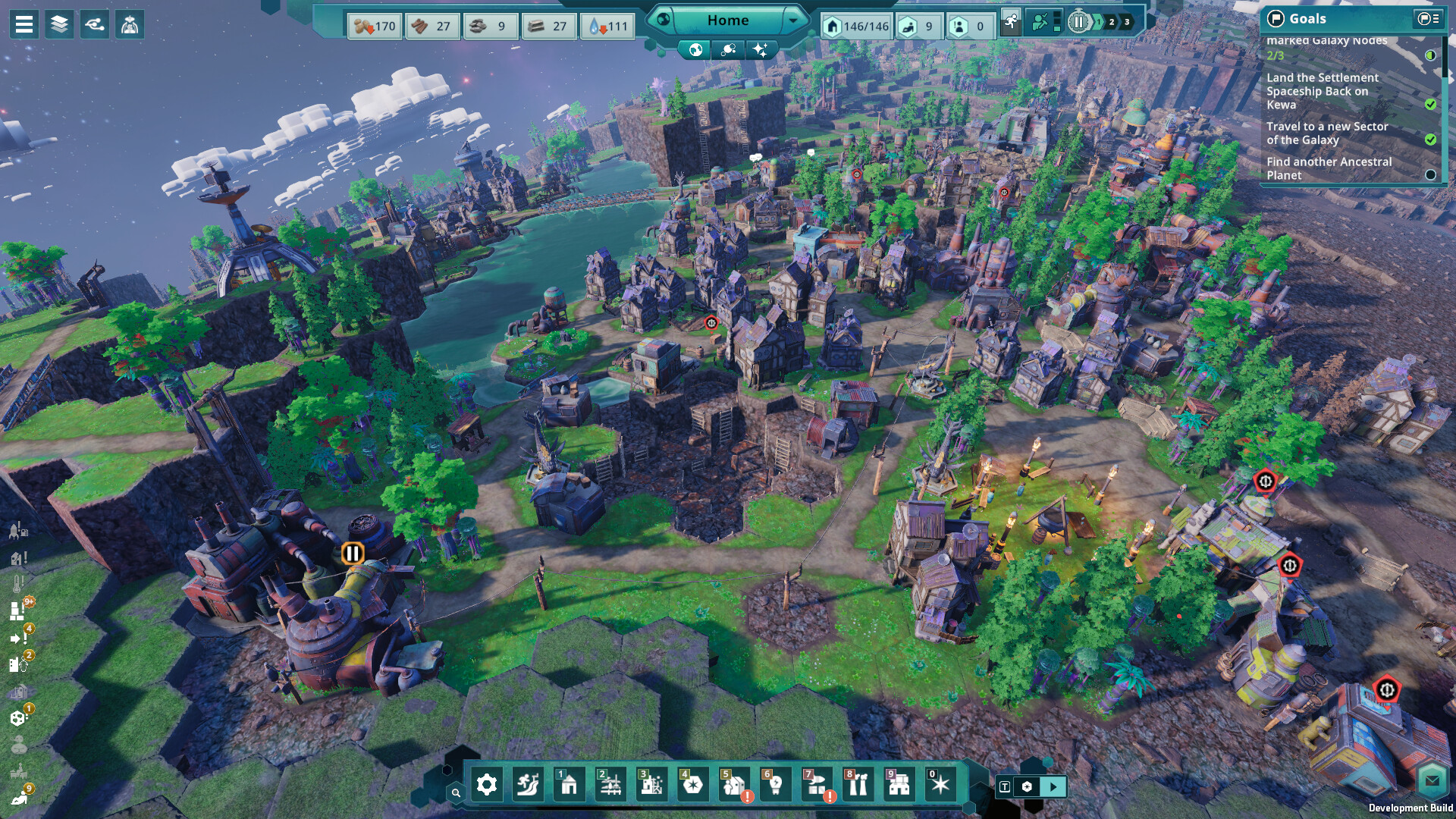
Start with the documented potato supply
The collected Home Spaceship material identifies the starting ship as a source of basic goods, including some of the potatoes used by the first settlement. Potato patches provide a way to expand that initial food production as the town grows. These are the early food sources supported by the research, without a fixed farm count or a promised timetable for supplying a particular population.
Treat the starting source as part of the opening arrangement rather than as proof that every later household will remain supplied. Establish the production and access relationships your settlement needs before concentrating on additional food varieties. If the initial supply appears insufficient, inspect the potatoes already being produced and where they are going before making a broader change to the economy.
Follow food from its source to homes
The collected Peeps reference describes food being brought into homes and consumed during breaks. That makes the household destination important when you are trying to understand whether food is actually available to the people who need it. A settlement-wide stockpile shows that the resource exists somewhere, but does not by itself establish access for every home.
Begin a food check with the affected households and then follow the connection toward the relevant supply. Review the source, the stored resource and the access associated with the home instead of relying only on the overall total. This is a practical investigation of the documented movement relationship rather than a claim that every hungry household is caused by the same production problem.
Separate production from distribution
More food production and better access to food answer different questions within the settlement. Adding potato patches addresses the source of the initial food supply, while examining storage and the connection to homes addresses where the food goes. Keep both questions visible when the town appears to have food but a particular part of the population is still not receiving it.
Identify which of those questions describes the current shortage before placing several new production buildings. If the source is producing potatoes, review their destination and household access; if it is not producing enough useful output, inspect the source itself. The dossier supports this distinction but does not establish a universal number of food buildings per Peep or one optimal layout for every settlement.
Expand from a usable early settlement
The dossier’s opening guidance places food alongside housing, water and accessible work, which gives the potato supply a role in the larger settlement plan. A larger food area still needs to connect with the homes intended to receive its output. Review that arrangement before expanding several other parts of the town which will increase demand at the same time.
Work from a specific shortage and observe what changes after you address it. This is a planning recommendation based on the documented sources and household behavior, not a tested rush strategy. It avoids inventing a consumption rate or an ideal reserve and instead uses the conditions you can inspect in the settlement you already have.
Find later food opportunities on planets
The developer’s settleable-planet preview describes cows and chickens as part of a later planetary opportunity. It also describes the Pasture building producing milk and eggs, giving concrete examples of food resources beyond the initial potato supply. These are full-game planetary features in the collected preview, not a statement that the same content is included in the downloadable demo.
Consider those later resources when planning why an outpost would be useful to the home settlement. The planetary source and the connection returning its output to Kewa both belong to that decision. A newly discovered food opportunity does not by itself establish that every home can receive it, just as a local potato stockpile does not prove access across the opening town.
Check the household before changing the diet
For a home missing food, begin with the potatoes or other specific food resource involved instead of treating every consumable as the same supply. The documented household collection behavior makes the destination an important part of the answer. Work back toward the source and stored goods so that a real food-production expansion is not mistaken for a solution to a separate access question.
If the early food source is functioning, inspect whether its output is reaching the homes expected to use it during breaks. A large total somewhere in the settlement does not supply that answer by itself. Keeping the source and household connection together provides a useful diagnostic sequence without assigning a fixed amount of consumption to every Peep or a guaranteed number of potato patches to each block.
When considering a later planetary food, keep the developer preview’s full-game scope attached to the opportunity. Milk and eggs from pastures describe real additional resources, but their presence in a preview does not establish their inclusion in the current demo. Follow the new source and its return supply as part of the outpost plan rather than treating more variety as an immediate remedy for every opening shortage.
Once the specific connection is working, observe the affected households before ordering another broad food expansion. That review helps determine whether the original question concerned supply, movement or a different basic need such as drinking water. It follows the collected planning approach and gives your next decision a visible purpose instead of an unsupported optimal-diet formula.
Diagnose the specific shortage first
A useful food diagnosis begins by identifying the resource and the households affected, then examining production, storage and access in that order. Make the next change at the part of the arrangement which is not delivering useful supply. Observe the result before assuming that the settlement needs a different diet or a larger number of identical buildings everywhere.
The collected sources establish the potato start, household collection and examples of later planetary food, but not a universally optimal diet. Keep the plan grounded in those documented relationships rather than extending them into invented bonuses or population formulas. Use the water guide for drink supply and the storage guide when food movement appears to be constrained by resource allocation or full inventories.
Sources & research scope
Game information on this page comes from the sources recorded in the dated research. Publisher-hosted wiki entries are community-maintained, and review judgments remain attributed to their writers. Planning advice applies those documented systems and does not claim personal playtesting.
- Home Spaceship — Beyond These Stars Official WikiPublisher-hosted community wiki; mechanics from the collected research snapshot. Cited by name from the dated dossier; this source is not linked here.
- Peeps — Beyond These Stars Official WikiPublisher-hosted community wiki; mechanics from the collected research snapshot. Cited by name from the dated dossier; this source is not linked here.
- Dev Blog #28 — Settleable PlanetsDeveloper or official storefront material recorded in the research dossier.